
Natural vs Man-made Chemical Refrigerant: What's Actually in Your Air-conditioner
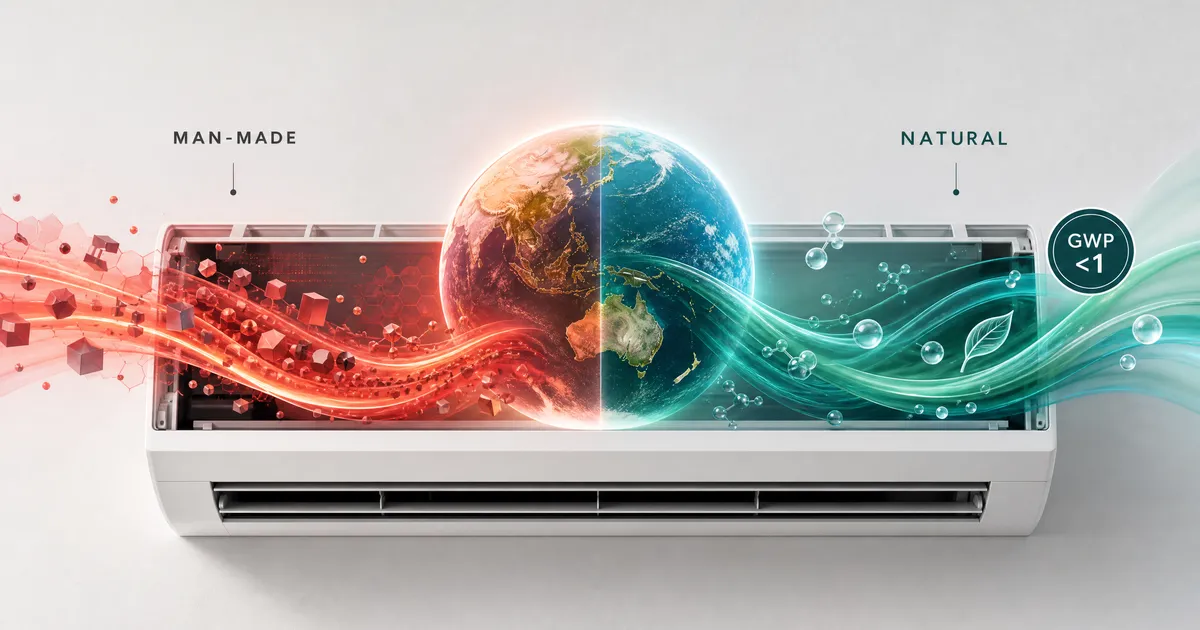
Most people have no idea what is circulating inside their Air-conditioner, let alone that they have a choice about it. If you have started looking into natural refrigerant air conditioning and found yourself lost in jargon, this is the plain-language comparison you have been trying to find.
We will cover what refrigerant actually does, the differences between man-made chemical refrigerants and the natural alternative, the safety question people quietly wonder about and how you would switch if you decided to.
What refrigerant does and why the type matters
Refrigerants are the working fluids used in all Air-conditioning and refrigeration systems worldwide, and they are what make cooling and heating possible. Refrigerant absorbs heat from one place and releases it in another, which is how your Air-conditioner pulls warmth out of your home in summer and brings it in during winter.
Because the refrigerant is doing the actual work of moving that heat, its substance matters. Different refrigerants carry heat with different efficiency, have very different environmental profiles and behave differently inside the same Air-conditioner unit. So the question of what is inside your system is not a technicality. It affects how well your system runs and what impact it has.
Man-made chemical refrigerants
Most Air-conditioners in Australian homes run on a man-made chemical refrigerant, commonly R22, R410a or R32. These are synthetic compounds that have been the industry standard for years.
They do the job, but they come with a well-documented downside: their environmental impact. Man-made chemical refrigerants have a global warming impact that is far higher than the natural alternative, which is a large part of why regulators have been phasing the older ones out of new systems. When these refrigerants leak, which systems can do over time, that impact is released into the atmosphere, contributing to global warming.
None of that makes your current system a problem to be ashamed of. It simply means there is now a cleaner option worth understanding.
Natural blended hydrocarbon refrigerant
The alternative is a natural blended hydrocarbon refrigerant. Engas is exactly that. Engas is the only manufacturer of it in the World and is made in Australia, right here in Perth.
Being naturally derived rather than laboratory-made, it carries a far lower environmental impact than the man-made chemical refrigerants it replaces, with a global warming potential (GWP) of less than 1. It also runs efficiently across both cooling and heating and, once it is in your system, it keeps working for the life of the Air-conditioner.
So the comparison, at its simplest, is this: a man-made chemical refrigerant with a high global warming impact, versus a natural blended hydrocarbon refrigerant with a GWP of less than 1 that also runs efficiently in your existing system.
But is it safe?
This is the question most people comparing refrigerants want answered honestly, so let us address it directly rather than skirt around it.
Hydrocarbon refrigerants are used safely in Air-conditioning and refrigeration systems around the world and they are handled under established standards. A conversion is carried out by a qualified technician who is trained to work with the product and to charge your Air-conditioner unit correctly. Done properly, by the right person, it is a safe and well-proven process.
Millions of refrigerators worldwide are running on hydrocarbon refrigerants, which are safe and efficient.
The honest short answer is yes, when it is installed correctly by a qualified professional, which is exactly how a Retro-fit is done.
Converting your existing system
If the comparison has you leaning toward the natural option, the good news is you do not need a new Air-conditioner to get there.
A Retro-fit converts the Air-conditioner unit you already own to Engas refrigerant. There is no new system to buy and no lengthy installation. A qualified technician does the conversion in a few hours and you keep using your Air-conditioner exactly as before. Based on Engas testing, homeowners can also see 25-40% electricity savings across both cooling and heating once converted, so the switch to a natural refrigerant tends to pay you back on your power bill too.
See if your system is suitable
If you would like to convert your Air-conditioner to a natural blended hydrocarbon refrigerant, the first step is simply finding out whether your Air-conditioner unit is a good candidate.
Book a free quotation and we will give you a clear, no-obligation picture of what is involved and what you could save across cooling and heating.
Book your free quotation
Find out how much you could save across both cooling and heating, with no obligation.
Book a free quotation